Seattle, WA — AI/ML Engineer

Skyler Carlson

Principal, Intelligence Engineering at Slalom. Ten years spanning systems engineering, machine learning, and production agentic platforms — building MCP servers, agentic workflows, and serverless/k8s full-stack applications on AWS, GCP, and Azure.

Skyler Carlson
50%LLM inference cost reduction via Bedrock batch pipelines
~$1M/yrsaved automating root-cause analysis workflows with AI
2U.S. patents — voice fingerprinting & RF signal separation
10 yrssystems engineering → data science & machine learning → agentic AI

Selected Work

2016 — present
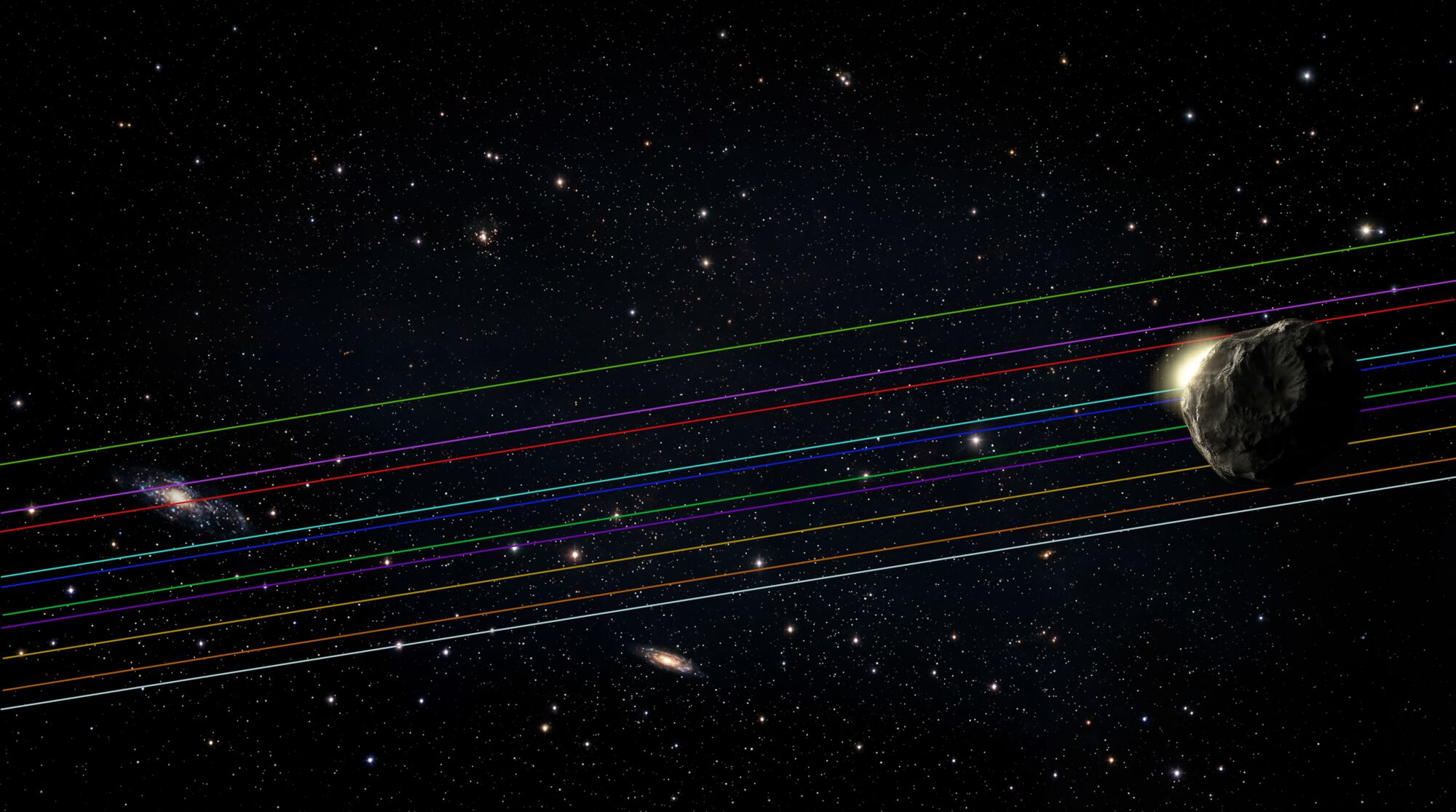
Occultation chords: parallel colored lines, one per observer, crossing the silhouette of an asteroid against a field of stars.Case study · 2025 — present

IOTA Hub

Sole developer of a serverless platform for a citizen-science astronomy organization — cut scientific data review from months to days for downstream consumers like NASA and ESA.

Astro/VueFastAPIAWSTerraformRead the case study
2026 — present

Deep-research agent platform

Engineering lead for a zero-to-one agentic system performing deep research and report writing. MCP servers plus agentic data-visualization and mapping capabilities.

MCPAgentsData viz & mapping
2025

Agentic Workflow Accelerator

Core contributor to Slalom’s cloud-agnostic agentic workflow engine — built MCP server capabilities and agent isolation functionality used across client engagements.

Agentic workflowsMCPAgent isolation
2024 — 2026

Production GenAI at Fortune 500 scale

Matured a beta GenAI application into a production MLOps platform while halving inference spend; separately built an event-driven personalization service that lifted email clickthrough 85%.

BedrockStep FunctionsMLOps

About

I'm passionate about building AI, ML, and automation-forward solutions to salient business problems. I'm a big-picture thinker who connects AI/ML to tangible business impact, then owns the whole stack to get it shipped — architecture, infrastructure, application code. I develop with Claude Code daily and thrive at the intersection of people, process, and automation.

Outside of work, I love to spend time outdoors! I spent six years as a mountain rescue technician in southern Arizona — 130+ missions with the Southern Arizona Rescue Association. These days I enjoy running (roads and trail) and exploring the Washington mountains. I also enjoy building software in my free time, tinkering with home automation, and gardening.

Experience & Education

résumé, abridged

Slalom

2024 — present
  1. 2026 — present

    Principal, Intelligence Engineering

    Engineering lead for an agentic deep-research platform for an AI infrastructure client — hands-on from architecture through production code to delivery.

  2. 2024 — 2026

    Machine Learning Architect

    Core contributor to the Agentic Workflow Accelerator; cut a Fortune 500 client’s LLM inference spend by 50%; led a team of three on an AI-accelerated legacy modernization with Codex. AI SME shaping agentic solution patterns in Azure AI Foundry for enterprise clients.

General Dynamics Mission Systems

2016 — 2024
  1. 2022 — 2024

    Advanced Data Scientist

    AI/ML Center of Excellence. Led a team of three running an enterprise RAG system with thousands of users; ~2x improvement in radio signal collision separation with neural networks.

  2. 2020 — 2022

    Senior Data Scientist

    Semantic segmentation for document layout analysis; object detection on synthetic aperture radar imagery; Python tooling for automated reporting.

  3. 2016 — 2020

    Systems Engineer → Senior Systems Engineer

    Automated ~50% of root-cause analysis ticket workflows with AI (~$1M/yr saved); SME for data servers and SQL operations across 30+ sites.

Education

2013 — 2021
  1. 2018 — 2021

    M.S., Data Science

    Johns Hopkins University

    Machine learning and advanced machine learning, computational statistics, statistical models and regression, algorithms for data science, and stochastic differential equations.

  2. 2013 — 2016

    B.S., Systems Engineering

    The University of Arizona

    Minor in Mathematics. Dean's List with Distinction; senior design team leader for an autonomous-vehicle testbed for GNC algorithm testing.

Patents & Publications

U.S. Patent · 2026

Voice Fingerprinting System for Detecting Hoax Emergency Reports

U.S. Patent 12,615,335 B2 · issued Apr 2026 · Carlson
USPTO ↗
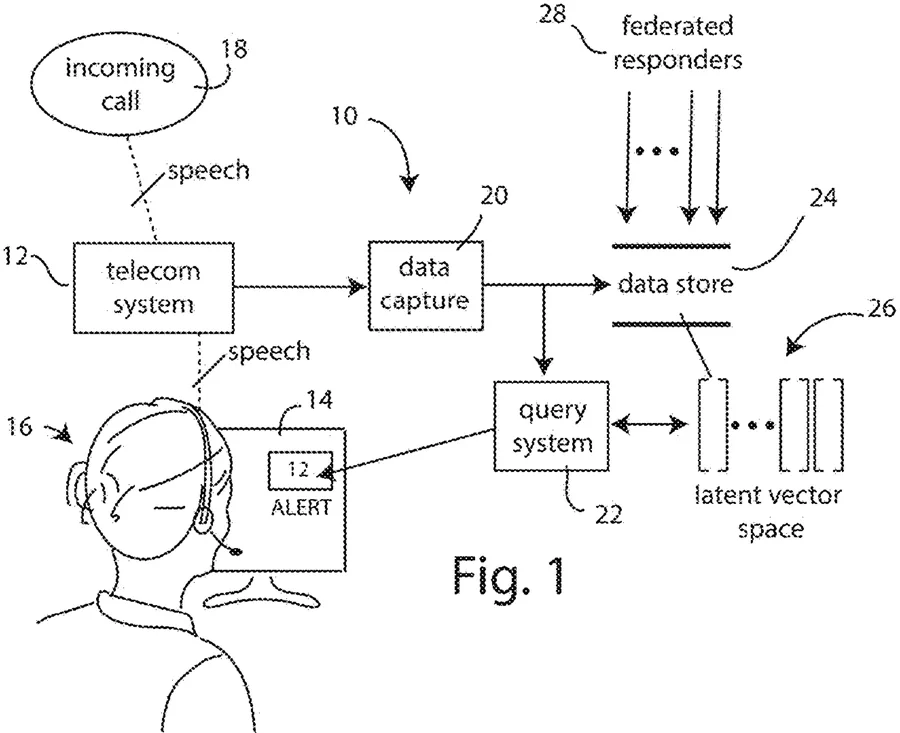
Patent figure: incoming call speech flows through data capture into a data store and latent vector space; a query system alerts the call operator.

Real-time speaker recognition for emergency call centers: incoming caller audio is embedded into a latent vector space by a neural network, and a similarity query alerts the dispatcher — while the call is still live — when the voice print matches known hoax callers.
U.S. Patent · 2026

System and Method for Training Machine Learning Systems That Separate Radio Signals Which Overlap in Frequency and Time

U.S. Patent application 18/439,904 · allowed Jul 2026 · Carlson et al.

USPTO ↗
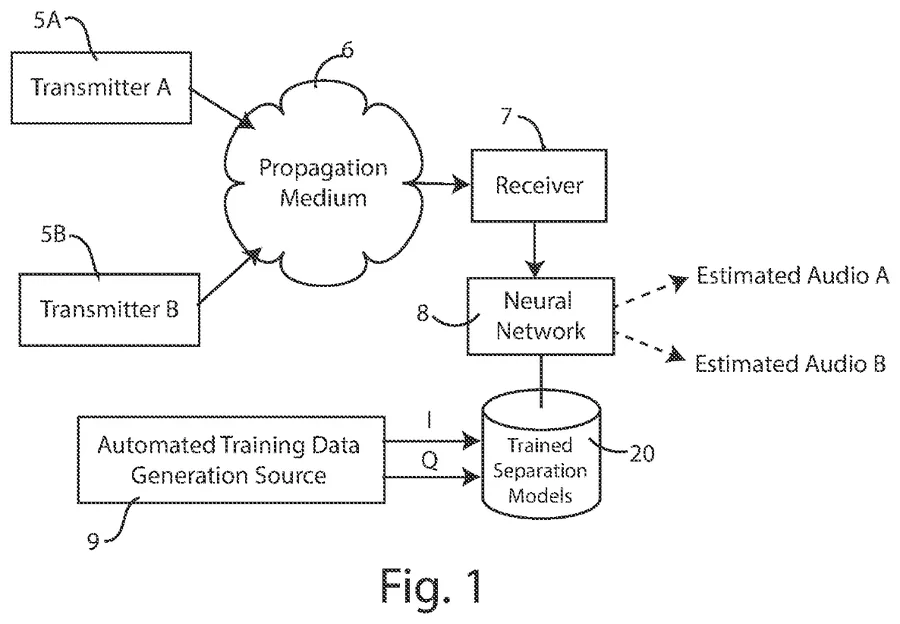
Patent figure: two transmitters collide in a propagation medium; a receiver feeds a neural network trained by an automated training data generation source.

A training pipeline that synthesizes colliding AM radio transmissions in the complex I/Q plane — modulation, tuning offsets, path loss, noise — and trains a neural separation model with SI-SNR loss to recover the individual transmissions from the collision.

SPIE Paper · 2023

Data Generation and Separation of AM Radio Collisions with Machine Learning

Proc. SPIE 12529 · Carlson, Liu, Leal, Palermo · doi:10.1117/12.2662948

SPIE ↗
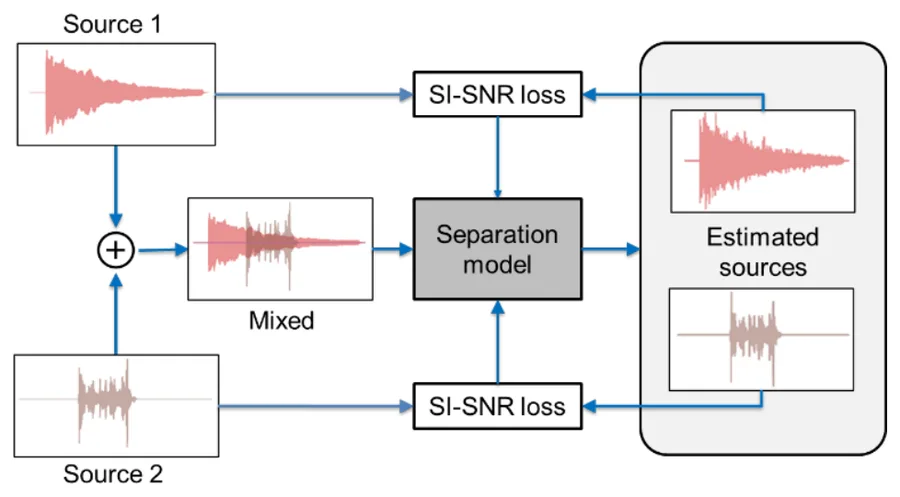
Figure from the paper: two audio sources are mixed and fed to a separation model; SI-SNR loss compares the estimated sources against the originals during training.

No datasets exist for AM radio separation, so we generated one: LibriMix speech modulated through a synthetic RF channel. A neural network operating on I/Q data achieves a 98.9% higher SI-SNR than the audio-only baseline — nearly 2× cleaner separation at every tuning offset.

SPIE Paper · 2023

StegAI: Detecting Steganography with Deep Learning

Proc. SPIE 12544 · Beatty & Carlson · doi:10.1117/12.2662974

SPIE ↗
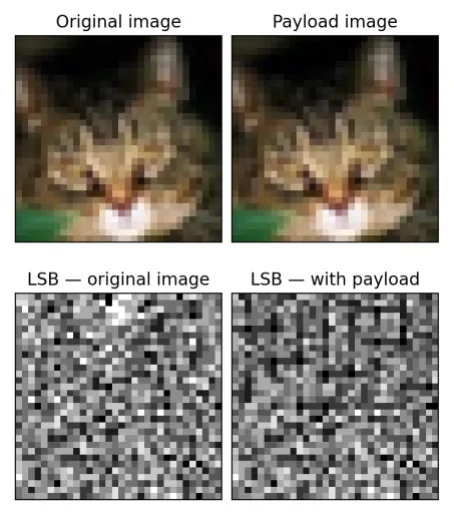
Figure from the paper: a cover image and its payload-injected twin look identical, but their isolated least-significant-bit planes differ visibly.

A convolutional network that detects least-significant-bit steganography in images at up to 96% accuracy — even when the hidden payload is AES-encrypted. Class-activation-map and entropy studies show the network keys on statistical fingerprints the payload leaves in the LSB plane.

Certifications

Contact

Open to interesting problems in agentic systems, applied ML, and the occasional astronomy side quest. The fastest way to reach me: